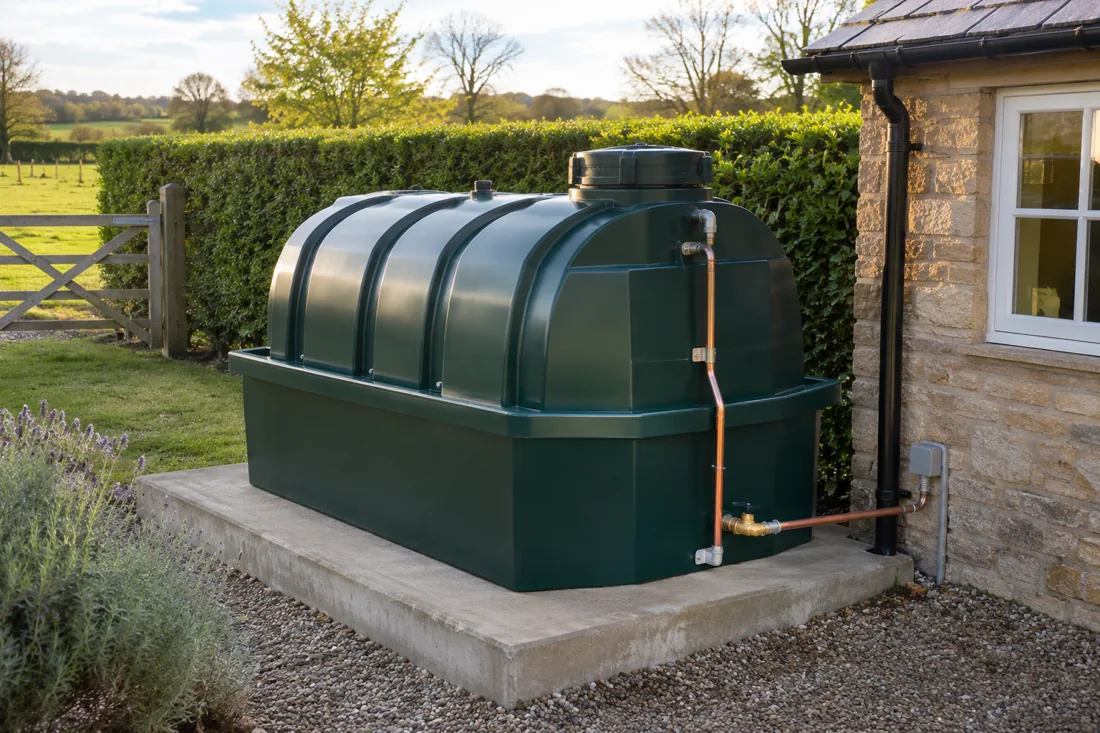
Decide What Needs Replacing
A split, bulging tank or badly corroded steel deserves assessment before the next delivery. Replacement can also follow a delivery refusal, an unsuitable position or building work that changes the space around the tank. For Oxfordshire homes and business premises, the useful starting point is the whole installation rather than a tank selected from a catalogue.
Tell us what prompted the enquiry and whether there is active leakage. A suspected spill changes the priority and may need environmental action alongside replacement. Do not wait for an ordinary quotation if oil is escaping. Our leaking tank guidance explains why containment and investigation must be considered separately from installing the new vessel.
Keep The Position Or Change It?
Keeping the existing position may reduce disruption, but the old location and base still need checking against the proposed tank and current requirements. A new tank can have a larger outer footprint even when its usable capacity is similar. The supporting area must suit its construction, not simply resemble the old base.
Moving the tank may improve delivery access or release space beside an extension. It can also require a new base and a longer oil line. Provide a photograph of the alternative location showing nearby buildings, boundaries, drains and vegetation. The installer should assess fire protection, pollution risk and practical access before a position is accepted.
Select Capacity And Containment Together
Your previous capacity is useful evidence, alongside fuel consumption and normal delivery arrangements. A bigger tank is not automatically the best choice if it dominates the available space or makes deliveries awkward. Horizontal, vertical and slimline shapes trade footprint against height, with access for inspection needed around the finished installation.
An integrally bunded tank has a containment enclosure around the fuel vessel. The need for containment is assessed for the property and its environmental setting. GOV.UK home oil storage guidance explains the domestic framework. A commercial installation needs its own assessment rather than borrowing a domestic specification.
Plastic and steel both have applications, but material alone does not establish suitability. Discuss the manufacturer's support requirements, access to fittings and the warranty conditions. Ask for the proposed model and dimensions in the quote so you can understand what will occupy the space.
Plan The Heating Interruption
Replacement involves a period with the oil supply disconnected. Agree the shutdown with everyone using the property and identify who can provide access to the boiler or plant. For a school, care setting or business, an authorised contact may need to approve isolation and restart arrangements.
Remaining oil is assessed before transfer. Usable fuel can sometimes be held temporarily and returned, while water and sludge need separate handling. A temporary supply may be worth discussing when base work or a staged move extends the interruption, but its availability, suitability and extra costs must be confirmed in advance.
Do not schedule a fuel delivery during the changeover. Tell the supplier when the new installation is ready and ask the installer what initial fill or operating checks are needed. A tank exchange and a boiler fault repair are different scopes, even though the heating system should be checked after reconnection.
Build A Quote You Can Compare
A useful replacement quotation identifies the tank, delivery, old tank removal, oil handling, base preparation and connection work. It should say whether filters, valves, gauges or oil line replacement are included. Where parts are retained, ask how their condition and compatibility will be checked.
The price changes with access, tank specification, ground preparation, temporary storage and disposal quantities. Narrow gates or a long route across a garden can alter handling arrangements. Send postcode, tank label, wide views, base details, fuel level and route photographs so any site visit can focus on the unresolved questions.
Handover And Future Care
Agree the Building Regulations notification route before the installation proceeds. OFTEC explains notification and competent person arrangements. Ask the appointed installer to identify the applicable completion records, commissioning information and manufacturer warranty rather than assuming a sales invoice covers everything.
Keep these records with your property documents, together with the model, serial number and date installed. Ask how to check the tank visually and when professional inspection is due. Keep access around the tank clear and report new distortion, staining or unexplained fuel loss rather than relying on the warranty period as a measure of condition.
Questions About This Service
Can The Existing Oil Be Kept?
Existing oil may be retained during a tank replacement if its condition is suitable and safe holding capacity is available. Water and sludge need separating from reusable fuel. Give an approximate level at enquiry stage and ask the quotation to explain transfer, temporary storage and disposal rather than assuming all contents will go back.
Will A Replacement Fit The Old Base?
A replacement tank does not necessarily fit the old base even when its nominal capacity matches. The outer dimensions, support requirements and condition of the base all matter. The installer should check the chosen model before confirming reuse, and list any enlargement, levelling or rebuilding work in the quotation.
Make The Enquiry Useful.
Send the postcode, tank details and access information. Include what you know about the oil remaining and any suspected leakage.
Enquire About Oil Tank Replacement